MetaWealth Retail
A revolutionary Real Estate investment model for retail investors, abandoned by the audience it was designed for. We built a new asset category on radical permission to drive conversion at scale.
Challenge
60% of people interested in investing excluded themselves before they ever started a rational validation.
Real Estate Investments see an annual flow of $50BUSD from retail investors, MetaWealth had built an innovative model offering those investors the returns, management and protections previously reserved for institutions. But they had fallen into a trap that left the vast market of retail investors culturally and functionally disconnected.
The standing identity was built on the presumptuous pedigree of luxury real estate, and the show-off-first explain-later costume of Web3.
That position left them competing with traditional investment vehicles for long-term stability and Web3 for access and outlandish returns. One isn't being looked for, one isn't believed. And neither have much shared value.
At the time, MetaWealth was the biggest Real-World Asset platform on the Solana network with $36MUSD under management, but the site couldn't convert new investors. Almost all new buusiness was handled by a sales team picking up abandoned leads. Internal research suggested buyers judged fees as too high and content as too complicated.
The standing identity was built on the presumptuous pedigree of luxury real estate, and the show-off-first explain-later costume of Web3.
That position left them competing with traditional investment vehicles for long-term stability and Web3 for access and outlandish returns. One isn't being looked for, one isn't believed. And neither have much shared value.
At the time, MetaWealth was the biggest Real-World Asset platform on the Solana network with $36MUSD under management, but the site couldn't convert new investors. Almost all new buusiness was handled by a sales team picking up abandoned leads. Internal research suggested buyers judged fees as too high and content as too complicated.



Solution
Designing for the moment someone decides this is for me
Netnography redefined what retail investors needed, the task wasn’t to add clarity or justify fees. It was to change who the experience signalled it was for.
The entire system was built around one shift: turning self-exclusion into permission. The portfolio became a single curated asset, so users weren’t asked to prove their judgment. The visual language moved from crypto-native to material and architectural, so the product felt stable, tangible and socially credible. And the journey introduced progressive depth, allowing trust to build through visible effort rather than forced simplicity. Each part of the brand and experienced was designed to reinforce the same idea: this is not something you need to qualify for. It’s something you’ve been excluded from.
The entire system was built around one shift: turning self-exclusion into permission. The portfolio became a single curated asset, so users weren’t asked to prove their judgment. The visual language moved from crypto-native to material and architectural, so the product felt stable, tangible and socially credible. And the journey introduced progressive depth, allowing trust to build through visible effort rather than forced simplicity. Each part of the brand and experienced was designed to reinforce the same idea: this is not something you need to qualify for. It’s something you’ve been excluded from.
Results
A brand experience that moved investors from people like me can't do this to I can't wait to tell someone I'm a Real Estate Investor.
Prototypes of the updated digital experience were tested with 12 participants, 100% expressed investment intent at session close. Predisposed buyers who had been made to feel excluded — people like me can't do this — now felt designed for, supported and motivated to invest.
The brand reversed the perception that had been driving abandonment, and the journey made visible dililgence a value-lever.
In the next 18 months, MetaWealth reached a top-15 global ranking among tokenised real-world asset platforms by volume (Financial IT, citing RWA.xyz). Macro forces shape every launch; timing, demand, and execution after the handoff all factor in.
The brand reversed the perception that had been driving abandonment, and the journey made visible dililgence a value-lever.
In the next 18 months, MetaWealth reached a top-15 global ranking among tokenised real-world asset platforms by volume (Financial IT, citing RWA.xyz). Macro forces shape every launch; timing, demand, and execution after the handoff all factor in.
.webp)

When category best practice costs sales
How high-context buying research reversed 60% bandonment
By 2025, tokenised real estate had earned its place as an innovative and credible retail investment tool - EU regulated, passive income + compound growth, fractional pricing, accessible.
The category had arrived. But retail investors weren’t buying in.MetaWealth had the product to close that gap: equity shares in high-end European residential developments, a €100 fractionalised buy-in, with the same institutional-grade opportunities typically reserved for the 1%, a EU VASP license, frictionless mobile-application-first access.
The category had arrived. But retail investors weren’t buying in.MetaWealth had the product to close that gap: equity shares in high-end European residential developments, a €100 fractionalised buy-in, with the same institutional-grade opportunities typically reserved for the 1%, a EU VASP license, frictionless mobile-application-first access.
How Much Do the Wrong Questions Cost?But what the business hadn't solved was the gap between a buyer who’s wondered about being a real estate investor, and that same investor selecting an investment and handing over the money.
Before the engagement kicked off, MetaWealth had already run their own research into why. Investor surveys mapped hesitation around fees, credibility, information transparency — rational friction points. But that wasn’t the part of the brain making the decision.
They asked: what do you need to invest? The limiting factor was, do you believe you're the kind of person who can?
That problem is what Mattermore is built for. Exploring why people do the things they do, in specific and consequential contexts.
We worked with MetaWealth to find and reframe their problem, and deliver a strategic brand and experience design programme that changed their sales journey.
Before the engagement kicked off, MetaWealth had already run their own research into why. Investor surveys mapped hesitation around fees, credibility, information transparency — rational friction points. But that wasn’t the part of the brain making the decision.
They asked: what do you need to invest? The limiting factor was, do you believe you're the kind of person who can?
That problem is what Mattermore is built for. Exploring why people do the things they do, in specific and consequential contexts.
We worked with MetaWealth to find and reframe their problem, and deliver a strategic brand and experience design programme that changed their sales journey.
The Perception TrapA research, strategy and experience design group ran an enthography programme, including contextual inquiry sessions with 14 predisposed investors across two panels: retail investors excited by stable, traditional assets, and crypto-native investors who had expressed interest in real-world assets. Both groups were warm prospects, self-selected for exactly what MetaWealth offered.
Watching investors move through the discovery and diligence journey, a pattern emerged early and consistently. When participants reached the portfolio section displaying multiple sold-out assets alongside a single availalble investment, the vibe changed. Shoulders dropped. Scrolling jumped.
One participant said it plainly: "These ones are gone. This one must be the one they couldn't sell." Eight of fourteen showed the same withdrawal. Sixty percent of predisposed investors were rejecting the product because the concerted signals were confirming a belief they had arrived with: I shouldn’t try and invest against property experts, I’m going to lose.
Watching investors move through the discovery and diligence journey, a pattern emerged early and consistently. When participants reached the portfolio section displaying multiple sold-out assets alongside a single availalble investment, the vibe changed. Shoulders dropped. Scrolling jumped.
One participant said it plainly: "These ones are gone. This one must be the one they couldn't sell." Eight of fourteen showed the same withdrawal. Sixty percent of predisposed investors were rejecting the product because the concerted signals were confirming a belief they had arrived with: I shouldn’t try and invest against property experts, I’m going to lose.
These were exactly the people who should have been saying yes. Which made watching them say no so interesting.
Identity Made Loss Aversion UnavoidableThere was a foundational gap between MetaWealth's self-diagnosis and what was happening as prospective investors explored the opportunity. An identity barrier was operating upstream of every functional and rational consideration, before marketing could start to build excitement or belief.
How will I look, trying to join a complicated, closed industry if I make an 'obviously' bad investment and lose money?
That fear turned an industry standard exclusivity and social proof signal, sell-through, into a brick wall. And demonstrated that the brand and experience needed not only to explain, but be a platform for radical identity permission and inclusion.
The researcher who documented that withdrawal and the designer shaping how MetaWealth meets buyers were in the same room. Insight shaped solutions right there; nuanced, aligned, built from the same thought.
How will I look, trying to join a complicated, closed industry if I make an 'obviously' bad investment and lose money?
That fear turned an industry standard exclusivity and social proof signal, sell-through, into a brick wall. And demonstrated that the brand and experience needed not only to explain, but be a platform for radical identity permission and inclusion.
The researcher who documented that withdrawal and the designer shaping how MetaWealth meets buyers were in the same room. Insight shaped solutions right there; nuanced, aligned, built from the same thought.
The Real Estate revolution won’t start until you can turn “I wish I could invest in that,” into “I can’t wait to tell someone.”
Traditional investment vehicles can't dissolve that barrier without dismantling the pedigree and exclusion the space thrives on. Equally, the buyers interested in property see crypto- as unforgivably volatile or a scam. And REITs offer accessibility and solid reults but neither selectivity nor community; or the feeling you're a real estate investor.
The permission to belong in an aspirational community — you can be a property investor, right here, from €100 — was genuinely unoccupied and had proven to motivate buyers. The commercial stakes of that opportunity were big. Big data research on Brand Growth shows that predisposing more people is one of the accelerators that will separate a brand outperforming from one that's just participating in a growing category.
MetaWealth had the product to do that. What it needed was the permission architecture to onbard the huge new audience, accouting for $50B+ annual retail flow into liquid real estate assets.
The permission to belong in an aspirational community — you can be a property investor, right here, from €100 — was genuinely unoccupied and had proven to motivate buyers. The commercial stakes of that opportunity were big. Big data research on Brand Growth shows that predisposing more people is one of the accelerators that will separate a brand outperforming from one that's just participating in a growing category.
MetaWealth had the product to do that. What it needed was the permission architecture to onbard the huge new audience, accouting for $50B+ annual retail flow into liquid real estate assets.

Redefining Ease as Earned ConfidenceCrypto propositions, largely, are racing to be simplest place to invest for the first time. MetaWealth had entered that race. But, when an investor is buying into stability; into brick & mortar, a counter intuitive effort heuristic; insist on more educative steps, translated to increased perceived value.
We removed sell-throughs, replacing the ecommerce popularity signal that translated to too-late, with an backward-looking overview of assets under management and performance; giving an institutional feel to evidence; rather than a volume shop.
We presented single investment opportunities in cannon; both removing analysis paralysis - which stopped novice investors in their tracks in user research - and allowing MetaWeath to showcase the global instituations, renowed partners and days of dilgience behind each investment opportunity.
These changes resolved compounding problems, allowing retail investors to see the selective diligence and institutional grade asset management empowering them to be Real Estate investors making the right investments.
“You don’t win trust in InvestTech by making things look easy — you win it by showing the effort that made it simple”
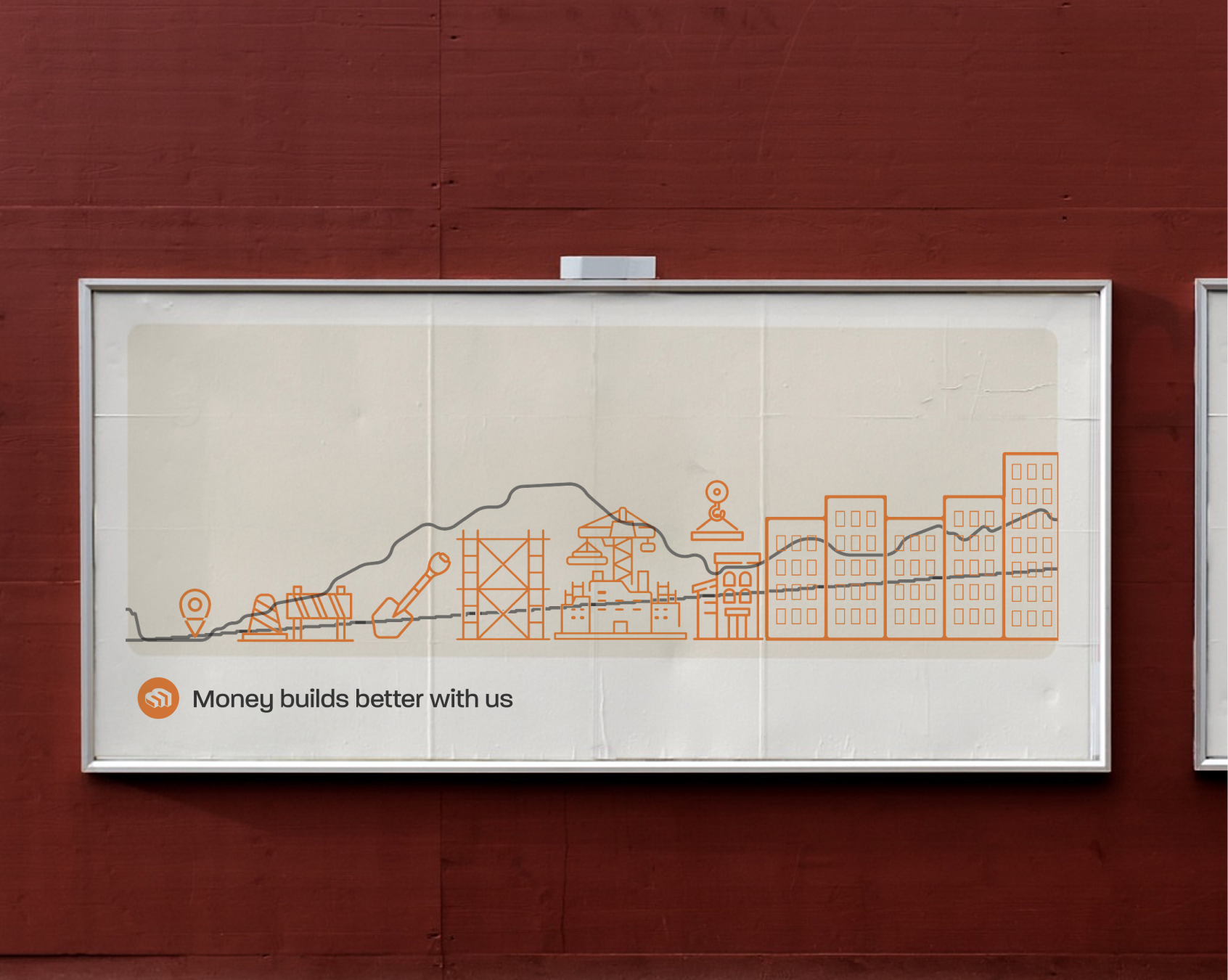
The visual language was architected to make the same argument . Every RWA competitor had inherited Web3's aesthetic: gradients, dark-mode gold, neon accents, holographic shapes. For an audience predisposed to property's stability — investors want something tangible, generational, real — those signals were functionally misplaced.
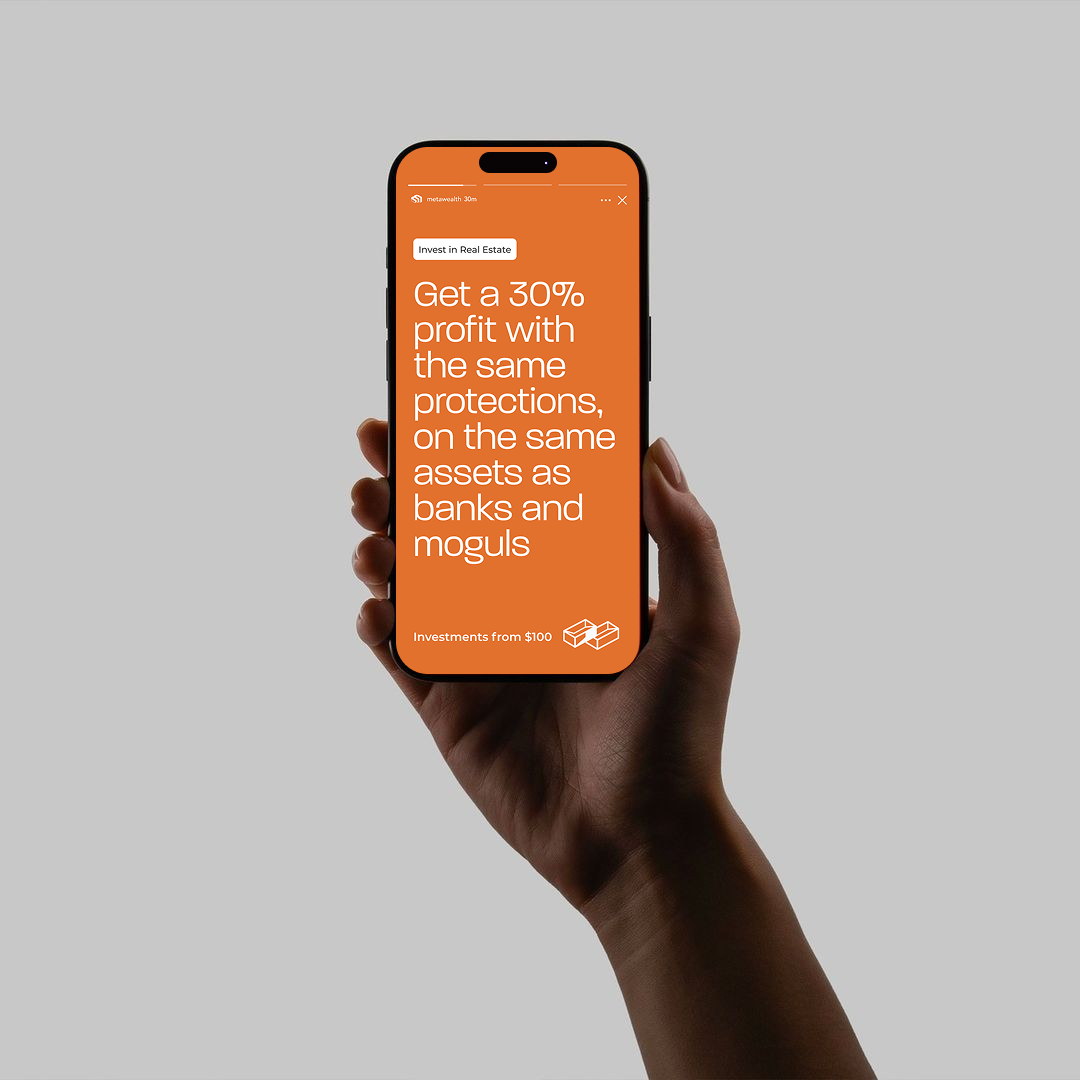
The design team built from materiality instead: terracotta for Mediterranean warmth and the possibility of a new kind of ownership, stone for permanence and institutional weight, steel and sand for approachable precision and simplicity. The palette addressed simultaneously what this audience feared about crypto and what they valued about property — in the same visual gesture.
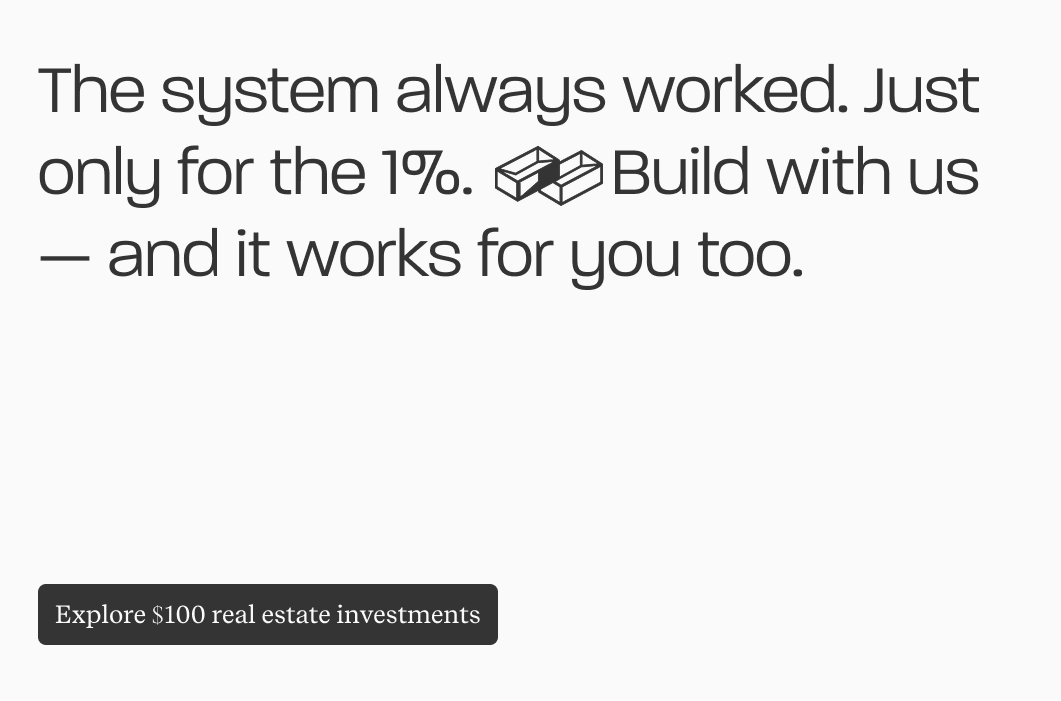
We added a matching mascot and icon system based on 8-bit bricks to bridge Web3 and bricks and mortar with a street-level fan feel.
A crypto-native platform cannot adopt this system without signalling that its own identity was ease of ease of access over curation. And a traditional property platform cannot adopt its warmth and democratic inclusion without undermining the exclusivity it defines its pedigree on.
We removed sell-throughs, replacing the ecommerce popularity signal that translated to too-late, with an backward-looking overview of assets under management and performance; giving an institutional feel to evidence; rather than a volume shop.
We presented single investment opportunities in cannon; both removing analysis paralysis - which stopped novice investors in their tracks in user research - and allowing MetaWeath to showcase the global instituations, renowed partners and days of dilgience behind each investment opportunity.
These changes resolved compounding problems, allowing retail investors to see the selective diligence and institutional grade asset management empowering them to be Real Estate investors making the right investments.
“You don’t win trust in InvestTech by making things look easy — you win it by showing the effort that made it simple”
The visual language was architected to make the same argument . Every RWA competitor had inherited Web3's aesthetic: gradients, dark-mode gold, neon accents, holographic shapes. For an audience predisposed to property's stability — investors want something tangible, generational, real — those signals were functionally misplaced.
The design team built from materiality instead: terracotta for Mediterranean warmth and the possibility of a new kind of ownership, stone for permanence and institutional weight, steel and sand for approachable precision and simplicity. The palette addressed simultaneously what this audience feared about crypto and what they valued about property — in the same visual gesture.
We added a matching mascot and icon system based on 8-bit bricks to bridge Web3 and bricks and mortar with a street-level fan feel.
A crypto-native platform cannot adopt this system without signalling that its own identity was ease of ease of access over curation. And a traditional property platform cannot adopt its warmth and democratic inclusion without undermining the exclusivity it defines its pedigree on.

Every design decision is an argument. We stay true to the problem, and ensure we're making the right one.
Right -moment Trust InterventionsDuring contextual inquiries, we observed trust and motivation moving independently across the journey; motivation spiking but trust crashing when users first encountered high ROI figures.
These wobbles had four distinct types: identity doubt, credibility collapse, decision paralysis, commitment anxiety. The UX process created four design & micropcopy patterns, each of the four intervention built to resolve a specific a wobble.
These wobbles had four distinct types: identity doubt, credibility collapse, decision paralysis, commitment anxiety. The UX process created four design & micropcopy patterns, each of the four intervention built to resolve a specific a wobble.
Designing for Radical Identity PermissionPrototypes of the digital journey were built, and tested with 12 participants — approximately 40% drawn from the original panel and 60% unexposed — 100% expressed investment intent at session close.
In the original sessions, 60% had abandoned the funnel. That shift wasn't a usability improvement. Predisposed buyers who had been self-excluding — people like me can't do this — now felt designed for, supported and motivated to invest.
In the original sessions, 60% had abandoned the funnel. That shift wasn't a usability improvement. Predisposed buyers who had been self-excluding — people like me can't do this — now felt designed for, supported and motivated to invest.
The Keys to the CateogryThe brand had reversed the perception that had been driving abandonment, and the journey made visible dililgence a value-lever.
Finding that problem required observational research close enough to catch the moment a shoulder dropped — and a design team close enough to design interventions with nuance and clarity.
That's the gap between a finding that informs a brief and a finding that defines work.
Meaningful difference, made consistently visible. Predisposing a huge new market.
In the next 18 months, MetaWealth reached a top-15 global ranking among tokenised real-world asset platforms by volume (Financial IT, citing RWA.xyz.
Finding that problem required observational research close enough to catch the moment a shoulder dropped — and a design team close enough to design interventions with nuance and clarity.
That's the gap between a finding that informs a brief and a finding that defines work.
Meaningful difference, made consistently visible. Predisposing a huge new market.
In the next 18 months, MetaWealth reached a top-15 global ranking among tokenised real-world asset platforms by volume (Financial IT, citing RWA.xyz.
Joey cooked for us, Mattermore really went in on the detail.
We encouraged everyone in the team to read their research and positioning work. It's foundational to democratising Real Estate.
We encouraged everyone in the team to read their research and positioning work. It's foundational to democratising Real Estate.
Jack Land, MetaWealth