BMR Property Group
Starting from zero brand presence we created a new breed of Property Fund proving human and financial outcomes can be the same thing, opening 7-figure conversations every week.
Challenge
Building a disciplined financial brand that can appeal to families and funds.
The UK needs more homes. Thinning inner-city opportunities are pushing mid-market residential developers into a new market. And the developers building them face a reputation problem. Look financially serious and everyone sees you as extractive. Look like you care about what you're building and you look underfunded. Most brands in the category have picked a side and surrendered half of the decision makers before a conversation begins.
BMR Property Group is a privately held property fund with a lean team and deep relationships, they had generated over half a billion pounds in gross development value in two years. Their work was financially disciplined and operationally precise, but invisible online. And, specialising in converting underutilised commercial buildings into homes they needed to appeal to both the civil planners and family-facing sellers that successful exits depend on.
BMR Property Group's sales and investment leaders needed a digital link in a traditionalist deal flow that would precede reputation, expand incoming interest and accelerate each demanding audience's diligence process.
BMR Property Group is a privately held property fund with a lean team and deep relationships, they had generated over half a billion pounds in gross development value in two years. Their work was financially disciplined and operationally precise, but invisible online. And, specialising in converting underutilised commercial buildings into homes they needed to appeal to both the civil planners and family-facing sellers that successful exits depend on.
BMR Property Group's sales and investment leaders needed a digital link in a traditionalist deal flow that would precede reputation, expand incoming interest and accelerate each demanding audience's diligence process.
Solution
A dual-mode decision making system that carries credibility and community
We positioned BMR as the developer that treats financial rigour and human outcome as the same decision — not a trade-off to be managed. Research with brokers, investors and planning stakeholders revealed a role-dependent trust architecture.
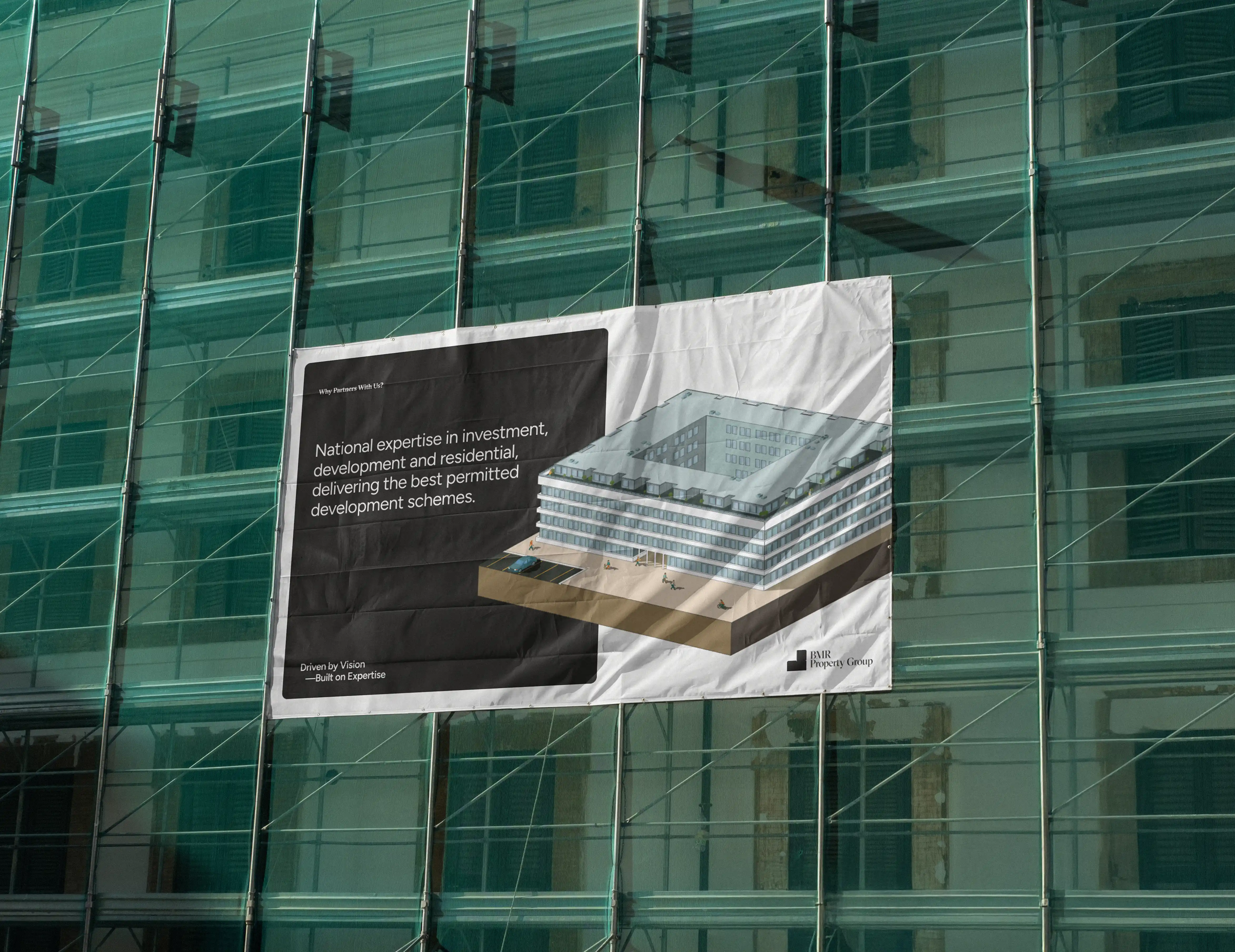
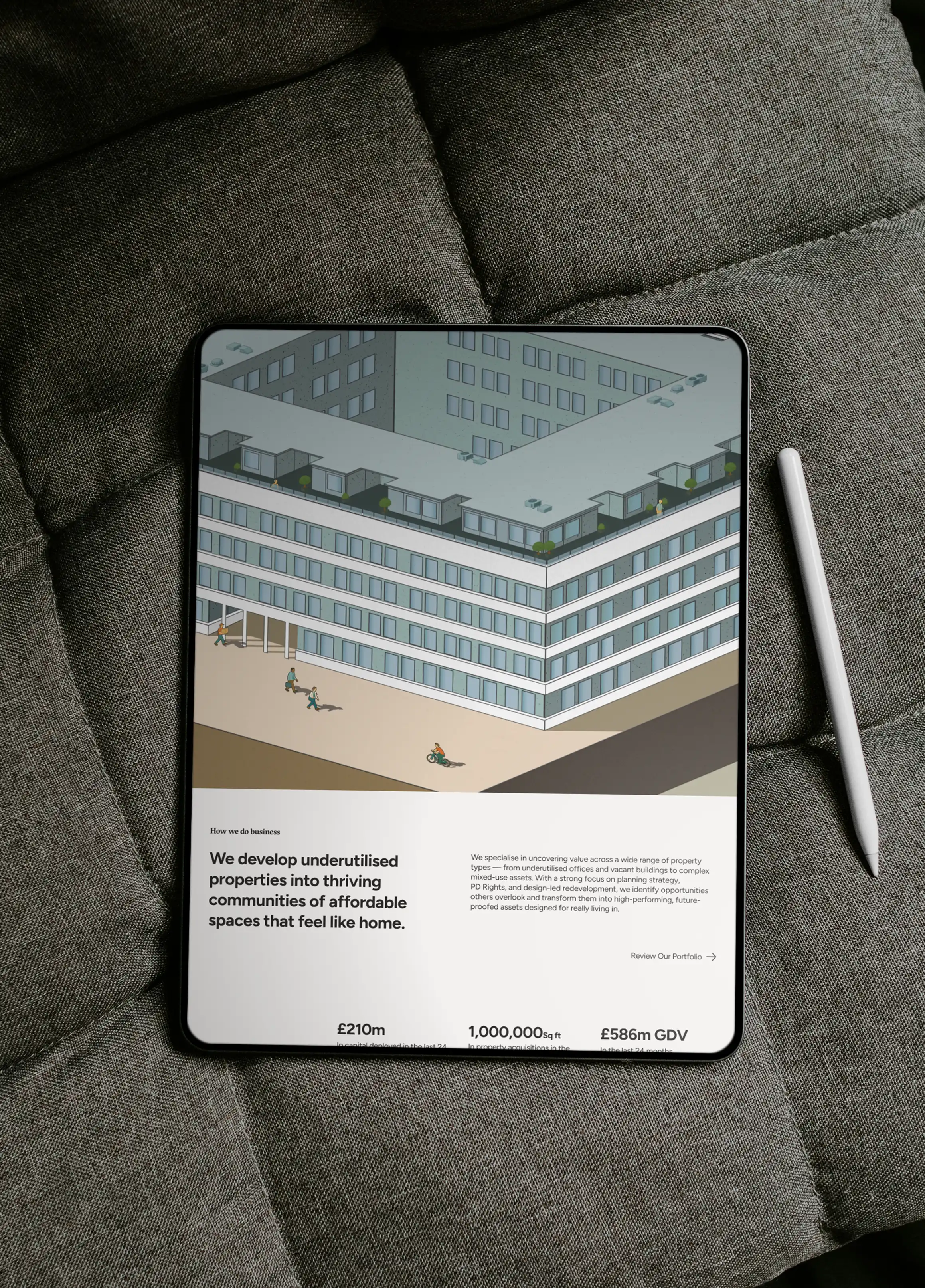
Each audience was asking different questions, at different speeds, with different thresholds for belief. The response wasn’t a single journey, but a system built to pass multiple tests simultaneously.The brand combined an asymmetric grid — signalling precision, control and effort — with isometric illustration, showing the lived reality of each development. The identity made both beliefs visible at once: disciplined returns and meaningful places to live.
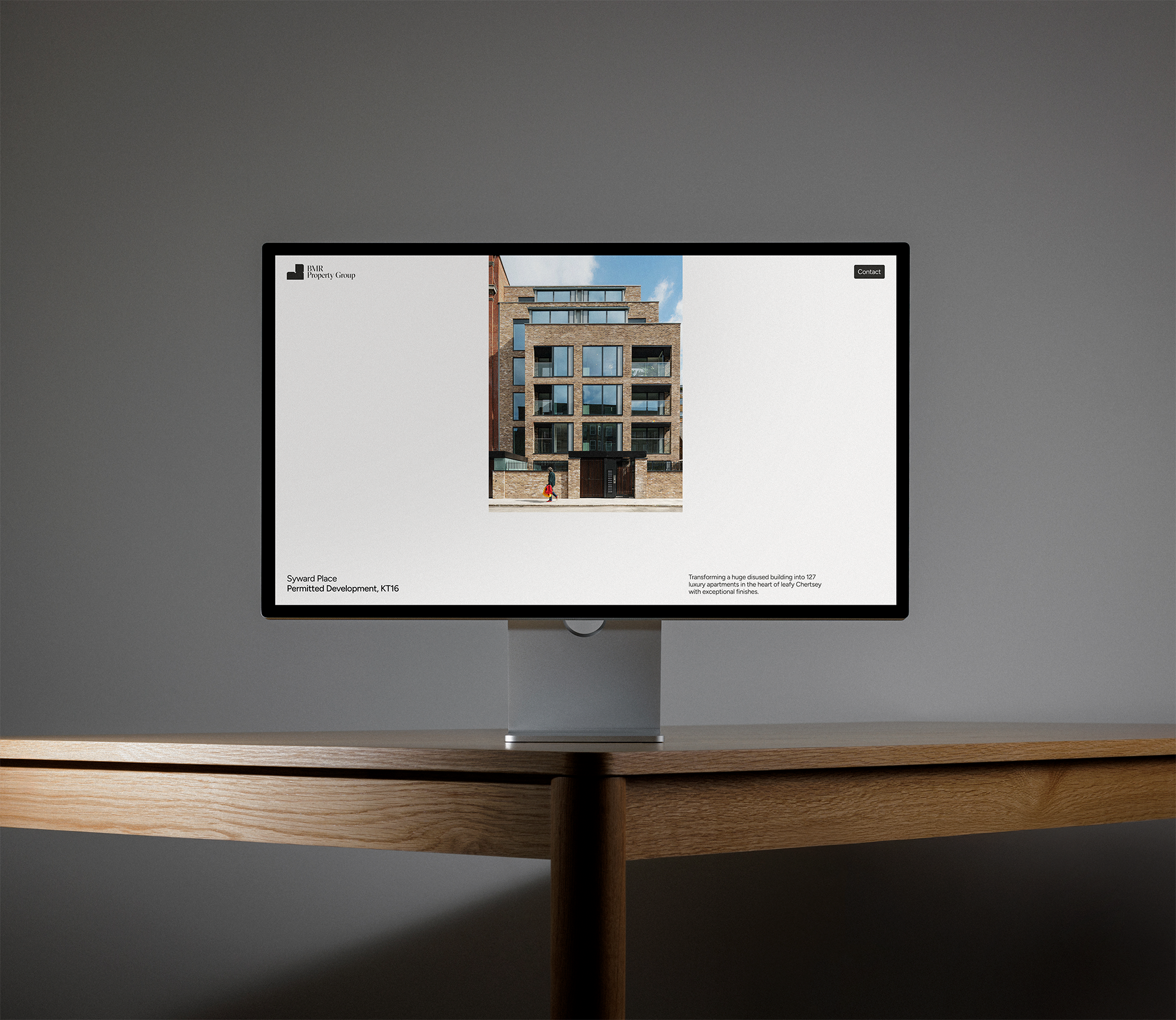
The experience followed the same logic. Mobile was designed for rapid broker validation, surfacing key signals in seconds. Desktop opened into structured, progressive disclosure for investor due diligence. Content and architecture were engineered around how deals actually begin — location, rights-type and known opportunities — ensuring BMR appeared exactly where decisions were already forming. Each decision reinforced the same position: a developer who believes both financial rigour and community intent together create the best outcomes.
Each audience was asking different questions, at different speeds, with different thresholds for belief. The response wasn’t a single journey, but a system built to pass multiple tests simultaneously.The brand combined an asymmetric grid — signalling precision, control and effort — with isometric illustration, showing the lived reality of each development. The identity made both beliefs visible at once: disciplined returns and meaningful places to live.
The experience followed the same logic. Mobile was designed for rapid broker validation, surfacing key signals in seconds. Desktop opened into structured, progressive disclosure for investor due diligence. Content and architecture were engineered around how deals actually begin — location, rights-type and known opportunities — ensuring BMR appeared exactly where decisions were already forming. Each decision reinforced the same position: a developer who believes both financial rigour and community intent together create the best outcomes.
Results
From invisible operator to a system that drives deal flow
BMR launched with a brand and platform that holds an unoccupied position in the category — one that larger, more established developers cannot move into without contradicting their investment manifesto, allowing each audience to find what they need without friction.
Brokers now validate new opportunities in under 8 seconds, increasing early-stage engagement and inbound volume. Investors spend 38% longer in structured sessions, arriving at conversations with higher confidence and deeper understanding.
That shift has translated directly into business impact. The platform is opening 7-figure deal conversations on a weekly basis, supporting a stronger, faster-moving pipeline. Within months of launch, the property group hired their first dedicated fund manager — a direct response to the quality and volume of new opportunities.
What was previously relationship-led is now systematised: a digital presence that precedes reputation, accelerates trust, and compounds deal flow.
Brokers now validate new opportunities in under 8 seconds, increasing early-stage engagement and inbound volume. Investors spend 38% longer in structured sessions, arriving at conversations with higher confidence and deeper understanding.
That shift has translated directly into business impact. The platform is opening 7-figure deal conversations on a weekly basis, supporting a stronger, faster-moving pipeline. Within months of launch, the property group hired their first dedicated fund manager — a direct response to the quality and volume of new opportunities.
What was previously relationship-led is now systematised: a digital presence that precedes reputation, accelerates trust, and compounds deal flow.
When competing decision makers share a URL
A new breed of home developer proving community and financial outcomes can be the same thing
81% of CRE validations involve an online experience, so "how does a positive developer connect with people who only see a tired stereotype? And how do they make small projects feel like a big idea?" — those questions, named a major perception problem.
A semiotic audit of the category's language made the opportunity visible. Every competitor had already committed to one of two visual registers — financial evidence or property renders — each of which signals only one half of what BMR genuinely was. That left the position entirely unoccupied: the developer that believes the most disciplined return and the most human outcome are the same thing.Sales cycle research confirmed the problem ran deeper than tone. Interviews with brokers, investors, and planning stakeholders — mapped against a behavioural diagnosis of how trust forms in high-stakes property decisions — produced something more definitive than audience segmentation: a role-dependent trust architecture.
A broker validating a new contact between meetings needs questions answered quickly: does this firm move fast and take submissions seriously? The decision is instinctive.
A semiotic audit of the category's language made the opportunity visible. Every competitor had already committed to one of two visual registers — financial evidence or property renders — each of which signals only one half of what BMR genuinely was. That left the position entirely unoccupied: the developer that believes the most disciplined return and the most human outcome are the same thing.Sales cycle research confirmed the problem ran deeper than tone. Interviews with brokers, investors, and planning stakeholders — mapped against a behavioural diagnosis of how trust forms in high-stakes property decisions — produced something more definitive than audience segmentation: a role-dependent trust architecture.
A broker validating a new contact between meetings needs questions answered quickly: does this firm move fast and take submissions seriously? The decision is instinctive.
A Blueprint for Decision MakersA capital allocator spending forty minutes on desktop before a call is asking something entirely different: is this track record real, is the structure sound, can I trust this with a serious commitment? That's deliberate, evidence-seeking, System 2. A planning officer needs something else again — evidence that the purpose is genuine, not performed.
Those aren't two versions of the same experience. They're separate decision architectures that share a URL.
Finding the unoccupied position required looking at who was actually in the room — and what each of them needed to believe.
Strategy and Design came together to make the call to define a developer who believes disciplined returns and human outcomes are the same thing, and began shaping the nuance to make that meaningful difference consistently visible.
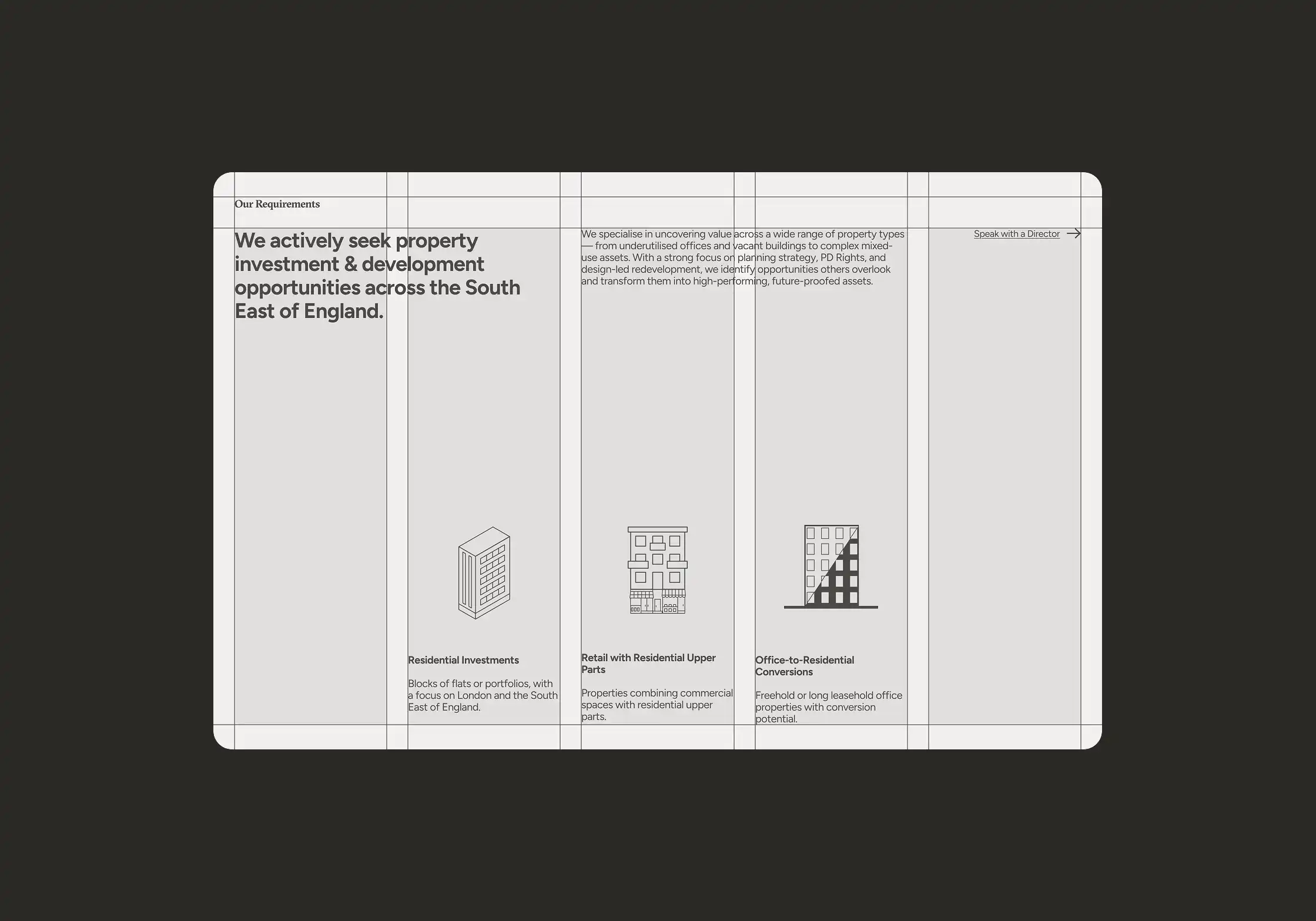
Their audience reads a visual systems as a proxy for operational intelligence. We developed an asymmetric grid — odd column counts, content placed deliberately off-centre — to give layouts the quality of a precise plan that still accommodates the unpredictable reality. This isn't aesthetic, it’s effort heuristic made spatial: the feeling that a team this considered in how they present themselves must be equally considered in how they build.
Those aren't two versions of the same experience. They're separate decision architectures that share a URL.
Finding the unoccupied position required looking at who was actually in the room — and what each of them needed to believe.
Strategy and Design came together to make the call to define a developer who believes disciplined returns and human outcomes are the same thing, and began shaping the nuance to make that meaningful difference consistently visible.
Their audience reads a visual systems as a proxy for operational intelligence. We developed an asymmetric grid — odd column counts, content placed deliberately off-centre — to give layouts the quality of a precise plan that still accommodates the unpredictable reality. This isn't aesthetic, it’s effort heuristic made spatial: the feeling that a team this considered in how they present themselves must be equally considered in how they build.
Reputation Travels FirstThe semiotic audit was equally specific about what illustration needed to do that photography and renders couldn't. Photography reads as staged. Renders are always empty. Isometric illustration — neat architectural frames filled with the detail of lives being lived: amenities, green space, children, bikes, the textures of neighbourhoods — is the only visual language that can simultaneously signal precision and warmth.
To meet the role-dependent trust architecture demands, we created a dual-mode UX.
The mobile experience borrowed its logic from industries that had already solved the problem of high-stakes content on small screens — education platforms, public sector services, nested library interfaces. Human-computer interaction research is clear on this: high visibility of next actions with minimal interaction cost will keep people moving in this context. The horizontal secondary navigation came directly from that principle, accelerating info discoverability during rapid validation.
To meet the role-dependent trust architecture demands, we created a dual-mode UX.
The mobile experience borrowed its logic from industries that had already solved the problem of high-stakes content on small screens — education platforms, public sector services, nested library interfaces. Human-computer interaction research is clear on this: high visibility of next actions with minimal interaction cost will keep people moving in this context. The horizontal secondary navigation came directly from that principle, accelerating info discoverability during rapid validation.
"Contacts tell us we have a class-leading site, and that feels important in an industry where reputation travels ahead of your first meeting.”
.webp)
A Floor Plan for Every Decision MakerCrucially, the site structure was organised around use cases, not content categories. Pages were defined by role-dependent validation journeys, sequenced to answering different questions in a different order — because the broker following a grapevine lead and the fund manager running due diligence are running different checks, and the architecture needed to answer both with equal speed and ease.
"We've always cared about whether someone could see themselves building a whole life in one of our schemes," Harvey Veitch told us.
The problem was, no one outside our relationships knew that."pipeline thickened — brokers now move from landing to first conversion action in <8 seconds, creating higher contact volume for live opportunities. Desktop sessions run 38% longer than industry benchmarks — and the more telling proof is qualitative: the client reports that prospects arrive to meetings more informed and engaged, preliminary work part done.
Within months, deal flow had grown enough that BMR brought on their first dedicated fund manager — a hire described as a direct consequence of the quality and volume of new conversations.
"We've always cared about whether someone could see themselves building a whole life in one of our schemes," Harvey Veitch told us.
The problem was, no one outside our relationships knew that."pipeline thickened — brokers now move from landing to first conversion action in <8 seconds, creating higher contact volume for live opportunities. Desktop sessions run 38% longer than industry benchmarks — and the more telling proof is qualitative: the client reports that prospects arrive to meetings more informed and engaged, preliminary work part done.
Within months, deal flow had grown enough that BMR brought on their first dedicated fund manager — a hire described as a direct consequence of the quality and volume of new conversations.
"We've always cared about whether someone could see themselves building a whole life in one of our schemes. The problem was, no one outside our relationships knew that. Now our brand tells that story.”
Harvey Veitch, BMR Property Group